Targets both query phrasings: resy vs opentable, opentable vs resy.
RESY VS OPENTABLE · REVIEWED AUGUST 2026
Resy vs OpenTable: which fits your restaurant in 2026?
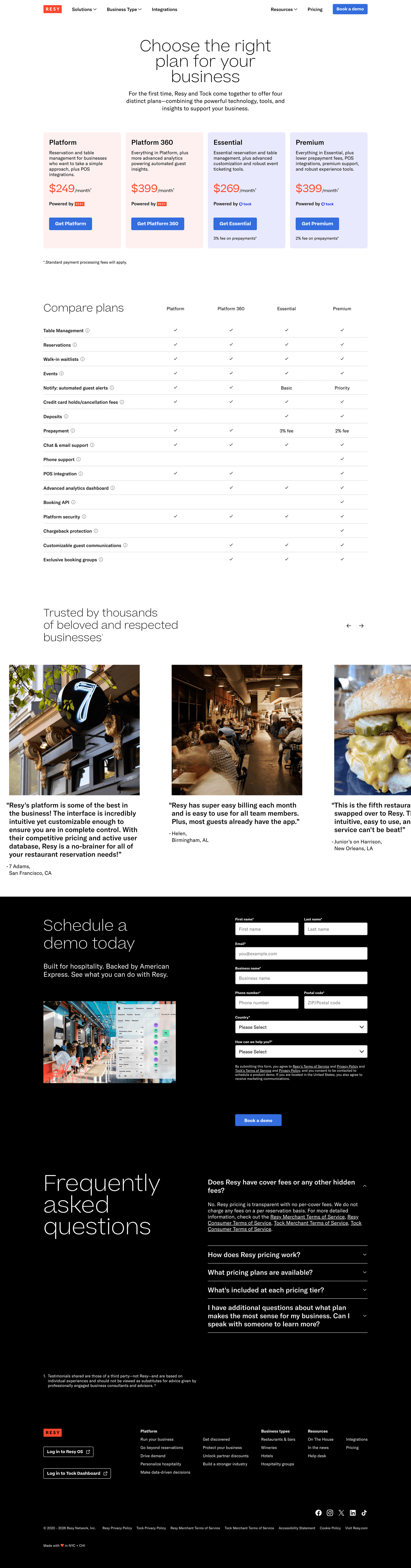
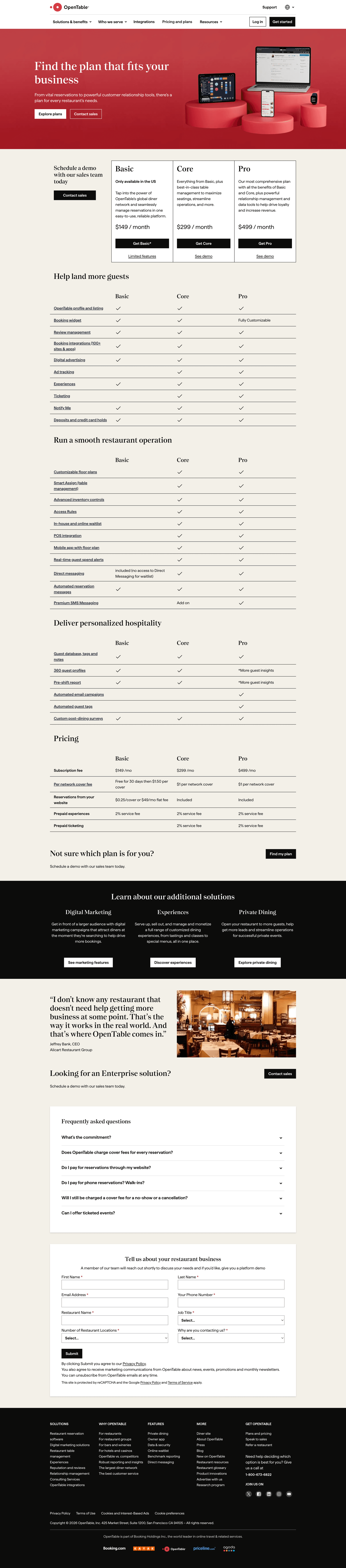
Resy and OpenTable are the two biggest names in US restaurant reservations, and they charge in opposite ways. Resy is a flat subscription: $249 or $399 a month with no per-cover fees (a higher $899 tier appears in some competitor comparison charts but is not on Resy's own pricing page). OpenTable is $149, $299 or $499 a month plus $1.00 to $1.50 for every diner its network sends you, and from 2026 a 2% fee on deposits it processes. Which one costs less depends entirely on how many covers the platform's own network brings you each month.
We publish this page and we sell a different product, so this comparison names what each platform does well and where Fork Time is not the answer. Every figure is from the vendors' published pricing and dated sources, last verified August 2026.
THE SHORT VERSION
Choose OpenTable if your tables are filled by discovery. It runs the largest diner network in the US, and a restaurant in a tourist-heavy or high-search market can treat the per-cover fee as a customer acquisition cost that pays for itself.
Choose Resy if your demand is already strong and you want a fixed bill. Above roughly 80 to 100 network covers a month, Resy's flat fee beats OpenTable's subscription plus cover fees, and the gap widens every month you get busier. Its network skews upscale and coastal, and the American Express relationship matters most to fine-dining rooms.
Choose neither as a complete answer if your losses happen on the phone. Both platforms manage the bookings that reach them. Industry analysis puts around 1 in 3 restaurant calls unanswered, and neither Resy nor OpenTable answers your phone, completes the booking, or refills the table when it cancels.
THE COST MATH
A restaurant seating 500 network covers a month pays Resy Basic $249. The same restaurant on OpenTable Basic pays $149 plus $500 to $750 in cover fees: $649 to $899 a month, before the 2% deposit fee. At 100 network covers the two are close to even. Below that, OpenTable's lower entry price wins on cost, and its network is more likely to be worth the fee.
WHAT CHANGED IN 2026
American Express, which has owned Resy since 2019, is merging Tock into Resy, with migration underway from mid-2026. That brings Tock's prepaid bookings and ticketed experiences into Resy as additional tiers ($269 a month with 3% on prepayments, or $399 with 2%), and roughly doubles Resy's venue inventory. If your model is prepaid menus and events, the merged Resy now covers ground that used to require Tock.
OpenTable's 2026 pricing added the 2% processing fee on deposits and prepayments, which matters if deposits are central to how you manage no-shows.
THE $1 GOOGLE REFERRAL FEE OWNERS DISCOVER LATER
The fee that generates the angriest operator threads is not the subscription. When a diner finds your restaurant on Google and books through OpenTable's integration, that booking is billed as a network cover at $1.00 to $1.50, including diners who searched your name and would have booked directly for free. Operators routinely report discovering this on their first invoice rather than in the sales conversation. One widely shared operator thread on the fee runs to over 70 comments, with the recurring phrase being some version of feeling scammed by it.
Two facts to hold together: the fee is disclosed in OpenTable's pricing, and it still surprises people, because "network cover" does not sound like "your own Google traffic." The fix that costs nothing: point your Google Business Profile's reserve button at your own booking page, and let OpenTable take only the bookings its marketplace genuinely originates. Resy's flat pricing makes this entire category of surprise impossible, which for some operators is the whole argument.
WHAT OPERATORS WHO SWITCHED ACTUALLY SAY
The recurring question in operator communities is not which platform has more features; it is "anybody switch, any regrets?" The consensus across those threads, paraphrased with permission of nobody because it is public: the platforms are closer in capability than the marketing suggests, the decision usually comes down to fee structure against local diner habits, and the discovery that tips people is almost always a fee they had not modelled, the Google referral charge on OpenTable's side, or the cost of Resy's higher tiers once the entry plan proves too thin. Operators in Resy-strong cities (New York above all) report the network genuinely fills seats; operators outside those cities report paying for a network their diners do not use.
WHAT LEAVING ACTUALLY INVOLVES
The question neither platform's sales page answers. Before you sign either, get written answers to four things, because they decide what leaving costs in two years: whether your guest records export in full (profiles, visit history, notes, not just emails), what notice the contract requires (OpenTable's standard agreement runs one year and auto-renews, with 30 days' notice required before renewal; Yelp Guest Manager's 12-month agreements carry early-termination fees of $600 on Essentials and $1,500 on Premium), whether your booking widget and Google reserve link can be repointed on day one, and what happens to future reservations already in the book. Diner-network bookings are the lock-in: a venue that leaves OpenTable keeps its own guests but loses the marketplace's, which is precisely why counting how many of your covers are genuinely network-originated (not just network-billed) is the single most important number to know before switching in either direction.
IF YOU ARE ON TOCK RIGHT NOW
The merger is not an abstraction for Tock venues: migration to Resy's platform is underway through 2026. Get written confirmation of three things from your account manager: whether your current Tock pricing carries into the Resy tiers or resets to the $269/$399 Tock-powered plans, when your migration window is scheduled and what happens to bookings and prepaid tickets already sold across the cutover, and whether your guest and ticketing history transfers complete. Venues that chose Tock specifically for prepaid ticketing keep that capability inside Resy; venues that chose Tock to avoid Resy now need a decision rather than a default.
WHERE EACH ONE WINS
OpenTable: the largest diner discovery network, the most POS integrations, and the most mature table management. If being findable where diners already search is your growth engine, nothing matches it.
Resy: predictable cost at volume, a brand that carries weight with an upscale audience, and Amex-side exposure to a high-spending diner base. Post-merger, the strongest prepaid and ticketed-experience tooling of the majors.
Both: neither answers your phone, neither scores individual bookings for no-show risk, and neither has a mechanism that refills a cancelled table. Those losses sit outside what either platform manages, which is the gap Fork Time exists for, alongside either platform or instead of one.
EVERY CALL ANSWERED
The bookings neither platform sees.
Fork Time answers the calls, completes the bookings and refills the cancellations that never reach a reservation platform. It works alongside the system you keep.