FORK TIME VS OPENTABLE · REVIEWED JULY 2026
Fork Time vs OpenTable: two different answers to where bookings come from
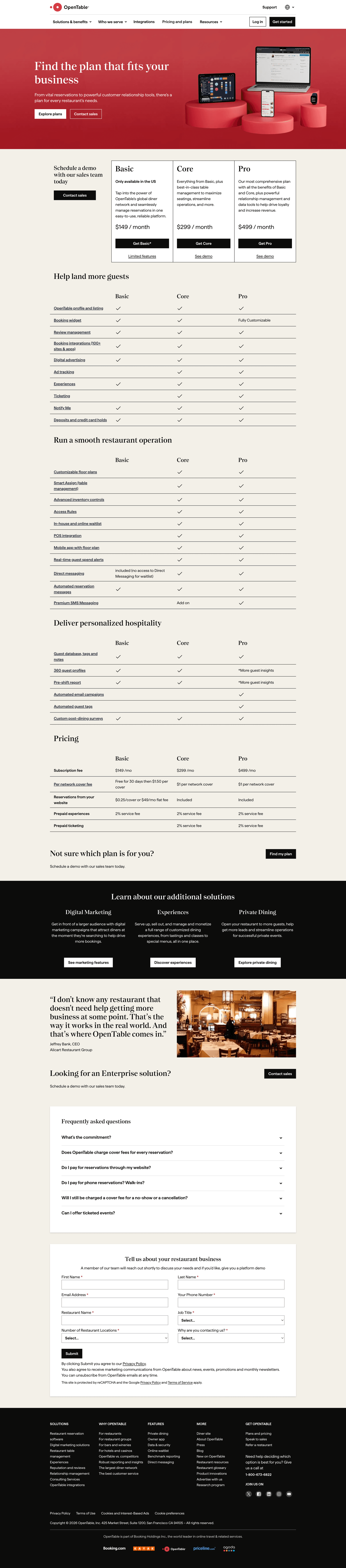
Fork Time is an OpenTable alternative for restaurants with demand they are already losing rather than demand they need to find. OpenTable pairs a diner marketplace with reservation software and charges $149 to $499 a month plus $1.00 to $1.50 for every cover its network sends. Fork Time charges $99, $199 or $299 per location per month with no per-cover fees, and answers phone, email, SMS, WhatsApp and web chat from inside its own live book. The trade is straightforward: OpenTable brings discovery that Fork Time does not, and Fork Time answers the channels OpenTable leaves to your team. If a third or more of your covers genuinely originate from OpenTable's network, its fees are buying you something. If they do not, they are charged on guests who already chose you.
Fork Time and OpenTable are built on opposite bets. OpenTable bets your next cover comes from its marketplace, and charges accordingly: $149 to $499 a month plus $1.00 to $1.50 for every cover its network sends, plus, in the United States, a 2% service fee on deposits, no-show penalties and prepaid dining. Fork Time bets your next cover is already trying to reach you, by phone, WhatsApp, SMS, web chat or an AI assistant, and charges a flat $99 to $299 a month to answer all of it from inside its own live book, with no per-cover fees. If you need to be discovered, OpenTable is the honest choice and this page says so. If you have demand and lose it to unanswered channels, that's the job Fork Time was built for.
HEAD TO HEAD
| Criteria | Fork Time | OpenTable |
|---|---|---|
| What it fundamentally is | AI front of house + reservation system | Diner marketplace + reservation software |
| Published pricing | $99 / $199 / $299 per month, USD | Basic $149 / Core $299 / Pro $499 per month |
| Per-cover fees | None | $1.00 to $1.50 per network cover; 2% service fee on deposits and prepaid dining, United States only |
| Diner discovery network | None | The largest in the category |
| AI answers the phone | Yes, built in, unlimited under fair use ($199 plan) | Via third-party voice AI integrations |
| AI answers WhatsApp, SMS, web chat | Yes | No |
| Bookable by AI assistants | MCP availability and booking tools for compatible clients configured with Fork Time | Not publicly documented |
| Deposits | Risk-scored per booking; most systems apply one blanket policy | Standard deposit tools; 2% service fee applies on some transactions |
| Cancellation recovery | Ranks likely guests, prepares the offer, team sends in one tap | Waitlist tools |
| Walk-in seating | Ranks the three best options with timing and conditions | Waitlist and floor tools |
| Guest data | Yours; full export if you leave | Network diner profiles accrue to OpenTable's marketplace |
| Setup | About 30 minutes from your URL | Fast; network onboarding |
| Trial | 14 days | 30-day free trial on Basic, new customers, card required |
| Contract | None | Varies by plan |
| Ownership | Independent, founder-led | Booking Holdings |
| Scale | Early Australian base incl. Il Caminetto (ranked in 50 Top Pizza Asia-Pacific 2026) | 60,000+ venues globally |
Verified 22 July 2026.
THE FEE MATH
OpenTable's network fee applies to covers booked through its marketplace; direct website and phone bookings on Core don't carry it. So the comparison depends on your network share:
| 150 covers/week on OpenTable Core | Annual cost |
|---|---|
| 100% network-sourced | ~$3,588 + $7,800-11,700 = $11,400-15,300 |
| 50% network-sourced | ~$3,588 + $3,900-5,850 = $7,500-9,450 |
| 25% network-sourced | ~$3,588 + $1,950-2,925 = $5,550-6,500 |
| Fork Time, any volume | $2,388 ($199 plan), $3,588 ($299 plan) |
The honest reading: at 100% network share, OpenTable's fees are buying you a full book and are arguably worth it. At 25%, most of the fee bill is charged on guests who already chose you. Pull one month of covers and count the split; that number, not this page, decides.
WHERE OPENTABLE WINS
Discovery, full stop. OpenTable's marketplace fills seats Fork Time cannot: new venues, tourist markets, soft midweek nights. Sixty thousand venues and two decades of diner habit are real assets. It also wins on ecosystem breadth: POS integrations, gift experiences and a brand every diner knows. If you took OpenTable away and your book emptied, stay on OpenTable.
WHERE FORK TIME WINS
Answering. One in three restaurant calls goes unanswered (The Restaurant Phone Report 2026, a first-party analysis of 1,067 Australian venues), and OpenTable doesn't answer any of them; Fork Time answers all of them, plus WhatsApp, SMS and web chat, from inside its own live book. Cost certainty: a flat published bill against a metered one. Data: every profile and visit history is yours, exportable in full. And the AI channel: Fork Time provides an MCP server exposing availability and booking tools to compatible clients configured with Fork Time, a channel OpenTable doesn't publicly serve.
RUNNING BOTH
Some venues keep OpenTable for genuine network demand and run Fork Time as the system of record for direct channels, shifting covers direct as demand matures. It doubles admin, so treat it as a transition. The one-month cover-source audit tells you when to finish it.
VERDICT BY RESTAURANT TYPE
New venue that needs to be found: OpenTable. Audit the fee-to-discovery ratio yearly.
Established independent losing calls and messages during service: Fork Time. The 14-day trial on your own menu is the fastest proof either way.
High OpenTable network share, growing direct demand: run both, shift direct, re-audit quarterly.
Venue where AI-assistant bookings matter to your guests: Fork Time; it's the only side of this page with a documented MCP path.
Weighing OpenTable against Resy rather than against Fork Time: the per-cover and flat-fee models are compared side by side in OpenTable vs Resy →
Fork Time publishes this comparison and is one of the two products in it. OpenTable's facts come from its published plans and documentation, the fee scenarios show their assumptions, and the discovery concession is stated plainly because it's true. Verified 22 July 2026. Corrections: support@forktime.ai.