OPENTABLE VS RESY · VERIFIED 16 AUGUST 2026
OpenTable vs Resy: Pricing, Fees & Best Fit (2026)
By Aadeel Khaan, CEO & Founder · Expert reviewed by Fork Time Research · Updated 16 August 2026
This comparison changed twice during 2026. American Express folded Tock into Resy in February, giving Resy a four-tier plan set and prepaid event tooling it did not previously own. OpenTable added a 2% service fee on prepaid experiences while continuing to charge per seated network cover. The two platforms now sit on opposite sides of one structural choice: OpenTable bills a lower subscription plus a fee for every seated network cover, and Resy bills a higher flat subscription with no per-cover or per-reservation fee under its public US pricing. At 2,000 network covers and 1,000 website covers a month, that choice is worth $38,376 a year on OpenTable Basic against $3,468 a year on Resy Platform.
OpenTable and Resy are restaurant reservation and table-management platforms with different cost structures. OpenTable's public US plans start at $149 a month and add fees for seated diners who originate on its network; Resy's public US plans start at $289 a month and state that there are no per-cover or per-reservation fees. OpenTable has the larger documented operating footprint and the broader public API and voice-AI partner ecosystem. Resy offers predictable subscription pricing, a 60-million-user network, American Express demand channels, Resy Notify and Tock-powered event tiers. The best choice depends less on the logo and more on how your bookings arrive, how much marketplace demand is incremental, which workflows your team needs, and whether a third-party phone or AI integration is acceptable.
Fork Time publishes this independent comparison and sells restaurant technology, but neither OpenTable nor Resy paid for placement. Prices are public US list prices in USD, checked against the vendors' live pages on 16 August 2026. Contract, country, payment-processing, hardware and negotiated charges can differ.
Written by Aadeel Khaan, CEO & Founder of Fork Time. Pricing arithmetic, source links and capability wording were expert reviewed by Fork Time Research.
THE SHORT ANSWER
OpenTable is the stronger fit when its discovery network can add profitable covers that the restaurant would not otherwise receive. It documents 65,000+ venues, 1.9 billion diners seated annually, broad restaurant-group tooling, a large API catalog and vetted integrations across POS, payments and voice AI.
Resy is the stronger fit when demand already comes through the restaurant's brand and owned channels and the operator wants a predictable bill. Its public pricing has no per-cover or per-reservation charges, while its network, American Express relationship, Notify alerts and Tock-powered tiers can still create demand.
Neither answer should be automatic. OpenTable Basic can cost less than Resy Platform when network volume is low. Resy can become much cheaper when hundreds of diners each month are billed as OpenTable network covers. Feature scope also changes by plan, so compare the workflow you need before comparing the totals.
| Decision | OpenTable | Resy | Fork Time |
|---|---|---|---|
| Best known for | Large diner discovery network and distribution | Flat subscription model and Amex-connected audience | AI front of house that answers calls and messages and holds the book |
| Public US entry price | $149/month for Basic | $289/month for Platform | $99/month for Reservations |
| Per-cover fees | $1.50 on Basic network covers; $1 on Core and Pro network covers | None under public pricing | None |
| Direct website booking fees | Basic: $0.25/cover or $49/month; included on Core and Pro | No per-reservation fee under public pricing | None |
| Phone and walk-in cover fees | No cover fee | No per-reservation fee under public pricing | None |
| AI phone answering | Third-party voice-AI integrations; confirm provider price and eligible plan | No included restaurant phone-answering product found in public Resy pricing or support documentation | from $199/month across phone, email, SMS, WhatsApp and web chat |
| Consumer AI booking | Documented discovery and booking paths with OpenAI, Perplexity, Alexa+ and Google experiences | Resy has announced US restaurant reservations inside ChatGPT and a Resy discovery/availability connector in Claude | Fork Time connects to ChatGPT, Claude and Gemini through MCP |
| Diner discovery network | The largest in the category | Strong in major metros, with American Express demand | None |
| Better default for | Discovery-led restaurants and groups needing broad integration depth | Demand-strong independents and operators prioritising predictable cost | Restaurants losing bookings to unanswered calls, emails and messages |
2026 PRICING AND FEES
OpenTable pricing
OpenTable publishes three US plans: Basic at $149 per month, Core at $299 and Pro at $499. Basic charges $1.50 for each seated network cover after a 30-day introductory period. Core and Pro charge $1 per seated network cover. Website reservations on Basic cost $0.25 per cover or $49 per month; website reservations are included on Core and Pro. OpenTable's public plan page lists a 2% service fee for prepaid experiences, with prepaid ticketing also listed at 2% on Core and Pro. Phone reservations and walk-ins do not carry a cover fee.
Resy pricing
Resy's live US page lists Platform at $289 per month and Platform 360 at $459 per month. The page says Resy does not charge per-cover or per-reservation fees. It also sells Tock-powered Essential at $289 with a 3% fee on prepayments and Premium at $459 with a 2% prepayment fee. Standard payment-processing fees apply. Platform is the simpler Resy reservation and table-management plan; Platform 360 adds more advanced analytics and tools such as Dashboard Booking.
| Published US price, 16 August 2026 | Subscription | Variable reservation fee | Important additional fee |
|---|---|---|---|
| OpenTable Basic | $149/month | $1.50 per seated network cover; website covers $0.25 or $49/month | 2% service fee on prepaid experiences |
| OpenTable Core | $299/month | $1 per seated network cover; website reservations included | 2% service fee on prepaid experiences and ticketing |
| OpenTable Pro | $499/month | $1 per seated network cover; website reservations included | 2% service fee on prepaid experiences and ticketing |
| Resy Platform | $289/month | No per-cover or per-reservation fee | Standard payment processing can apply |
| Resy Platform 360 | $459/month | No per-cover or per-reservation fee | Standard payment processing can apply |
| Resy Essential, powered by Tock | $289/month | No cover fee stated | 3% on prepayments plus standard processing |
| Resy Premium, powered by Tock | $459/month | No cover fee stated | 2% on prepayments plus standard processing |
Important: A network cover is a seated diner, not a reservation. A party of four can therefore create four cover fees. OpenTable says Core and Pro network fees apply when diners discover the restaurant through OpenTable's website, app or affiliate network. Basic also charges for bookings through the restaurant's website. Request a written channel-by-channel fee schedule before signing.
HOW MUCH DOES RESY COST?
Resy costs a restaurant $289 to $459 a month in the United States. Platform is $289 and Platform 360 is $459. The Tock-powered tiers match those prices, with Essential at $289 and Premium at $459, and add prepayment fees of 3% and 2%. Because there is no per-cover or per-reservation fee under Resy's public pricing, a venue on Platform pays $3,468 a year whether it seats 200 covers a month or 2,000. Standard payment-processing charges still apply on top.
Is Resy free?
Resy is free for diners. Searching, booking and joining Notify through the Resy app or website costs a guest nothing. It is not free for restaurants. Resy's public US pricing has no free tier and no published free trial, so the entry cost for a venue is the $289 Platform subscription.
How does Resy make money?
From restaurant subscriptions rather than from commission on bookings. Resy charges each venue a flat monthly fee, adds prepayment percentages on the Tock-powered tiers, and earns standard payment-processing revenue. Resy is owned by American Express, which uses Resy reservations and access as a card benefit. The practical consequence for an operator is that Resy's bill does not rise when Resy sends the restaurant more diners.
How much does Resy charge restaurants per reservation?
Nothing under its public US pricing. Resy states that it charges no per-cover and no per-reservation fees, so the monthly subscription is the whole platform cost before payment processing. This is the structural difference from OpenTable, which charges $1.50 per seated network cover on Basic and $1 on Core and Pro, plus $0.25 per website cover on Basic.
ACTUAL MONTHLY COST EXAMPLES
The examples below use public subscription and cover prices only. They exclude taxes, payment processing, prepaid-experience fees, hardware, SMS add-ons, voice-AI provider fees and negotiated services. Phone reservations and walk-ins are shown as $0 cover-fee channels in the OpenTable model.
| Monthly seated-cover mix | OpenTable Basic | OpenTable Core | OpenTable Pro | Resy Platform | Resy Platform 360 |
|---|---|---|---|---|---|
| 0 network, 500 website | $198 | $299 | $499 | $289 | $459 |
| 100 network, 500 website | $348 | $399 | $599 | $289 | $459 |
| 500 network, 500 website | $948 | $799 | $999 | $289 | $459 |
| 2,000 network, 1,000 website | $3,198 | $2,299 | $2,499 | $289 | $459 |
The same mixes expressed as annual cost, because a per-cover fee compounds across a year rather than a month:
| Annual cost at the same cover mix | OpenTable Basic | OpenTable Core | OpenTable Pro | Resy Platform | Resy Platform 360 |
|---|---|---|---|---|---|
| 0 network, 500 website | $2,376 | $3,588 | $5,988 | $3,468 | $5,508 |
| 100 network, 500 website | $4,176 | $4,788 | $7,188 | $3,468 | $5,508 |
| 500 network, 500 website | $11,376 | $9,588 | $11,988 | $3,468 | $5,508 |
| 2,000 network, 1,000 website | $38,376 | $27,588 | $29,988 | $3,468 | $5,508 |
A restaurant seating 500 network covers a month pays $11,376 a year on OpenTable Basic against $3,468 on Resy Platform, a difference of $7,908. At 2,000 network covers a month the gap reaches $34,908 a year. The entire difference is the per-cover fee, not the subscription.
At zero network covers and 500 website covers, OpenTable Basic is $91 less than Resy Platform. With the same website volume, Resy Platform becomes cheaper than Basic at about 61 seated network covers because Basic has already reached its $49 website-fee cap. With no website fees in the model, the crossover is about 94 Basic network covers. Core and Pro include more functionality than Basic, so these numbers compare public fees, not feature equivalence.
Interactive fee model
Enter your monthly seated covers.
Phone and walk-in covers are included in the mix but add no cover fee in this public-price model.
Public US subscription and seated-cover charges only. Taxes, payment processing, prepaid-experience fees, hardware, SMS, AI phone providers and negotiated add-ons are excluded.
FULL FEATURE COMPARISON
| Capability | OpenTable | Resy |
|---|---|---|
| Per-cover fees | Yes, by plan and booking source | No under public US pricing |
| Direct website bookings | Basic: $0.25/cover or $49/month; included on Core and Pro | without a public per-reservation fee |
| Staff-entered phone reservations | Supported; no cover fee | Supported in ResyOS; web Dashboard Booking is listed for Platform 360 |
| AI phone answering | Separate third-party voice-AI integrations are documented | No included restaurant phone agent found in public plan documentation |
| Walk-ins | In-house and online waitlist tools; walk-ins have no cover fee | Walk-in waitlist and ResyOS seating workflows |
| Waitlist and cancellation demand | In-house/online waitlist and Notify Me | Walk-in waitlist and Resy Notify alerts |
| Table management | Floor plans, Smart Assign, inventory controls and access rules | Floor plan, pacing, inventory and table-management workflows |
| Guest CRM | Guest database, tags and notes; deeper guest insights on higher plans | Guest profiles, notes and analytics; advanced insights on Platform 360 |
| No-show protection | Deposits, credit-card holds, cancellation policies and experiences | Credit-card holds, cancellation fees, deposits and prepayments by plan/workflow |
| Deposits and prepayment | Available; public plan page lists 2% service fees for prepaid products | Available; Tock-powered tiers list 3% or 2% prepayment fees |
| Events and experiences | Experiences and ticketing across public plans; private-dining lead tools sold separately | Events across the plan set; Tock-powered tiers add stronger ticketing and experience tools |
| POS integrations | Broad catalog; 200+ vetted integrations are claimed across POS, payments, voice AI and more | Public integrations include major POS systems; availability varies by country and plan |
| APIs | Public catalog for booking, CRM, directory, menus, POS, private dining, reviews, sync and profile content; approval required | Booking API and partner integrations are documented; access and plan eligibility should be confirmed |
| AI-agent booking | Multiple documented AI discovery/booking relationships plus purpose-specific booking APIs | Announced reservation booking in ChatGPT and discovery/availability through Claude |
| Multi-location support | Dedicated restaurant-group and enterprise product | Hospitality-group support and multi-venue workflows, with tier-dependent controls |
PRODUCT WORKFLOWS IN PICTURES
The full-width captures below come from public vendor support documentation. They show selected workflows, not every feature or plan entitlement. Open each image to inspect the original frame without cropping.
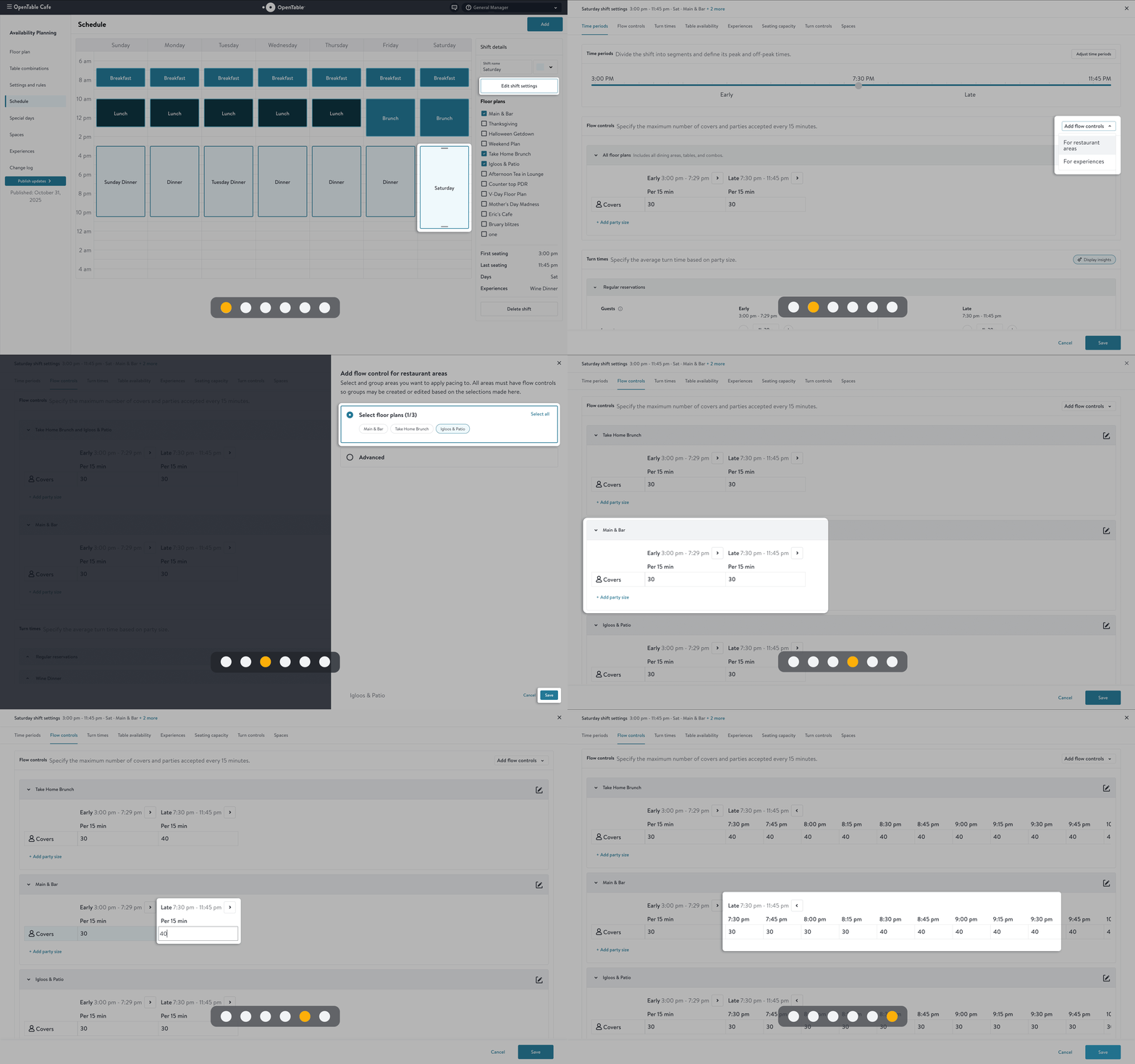
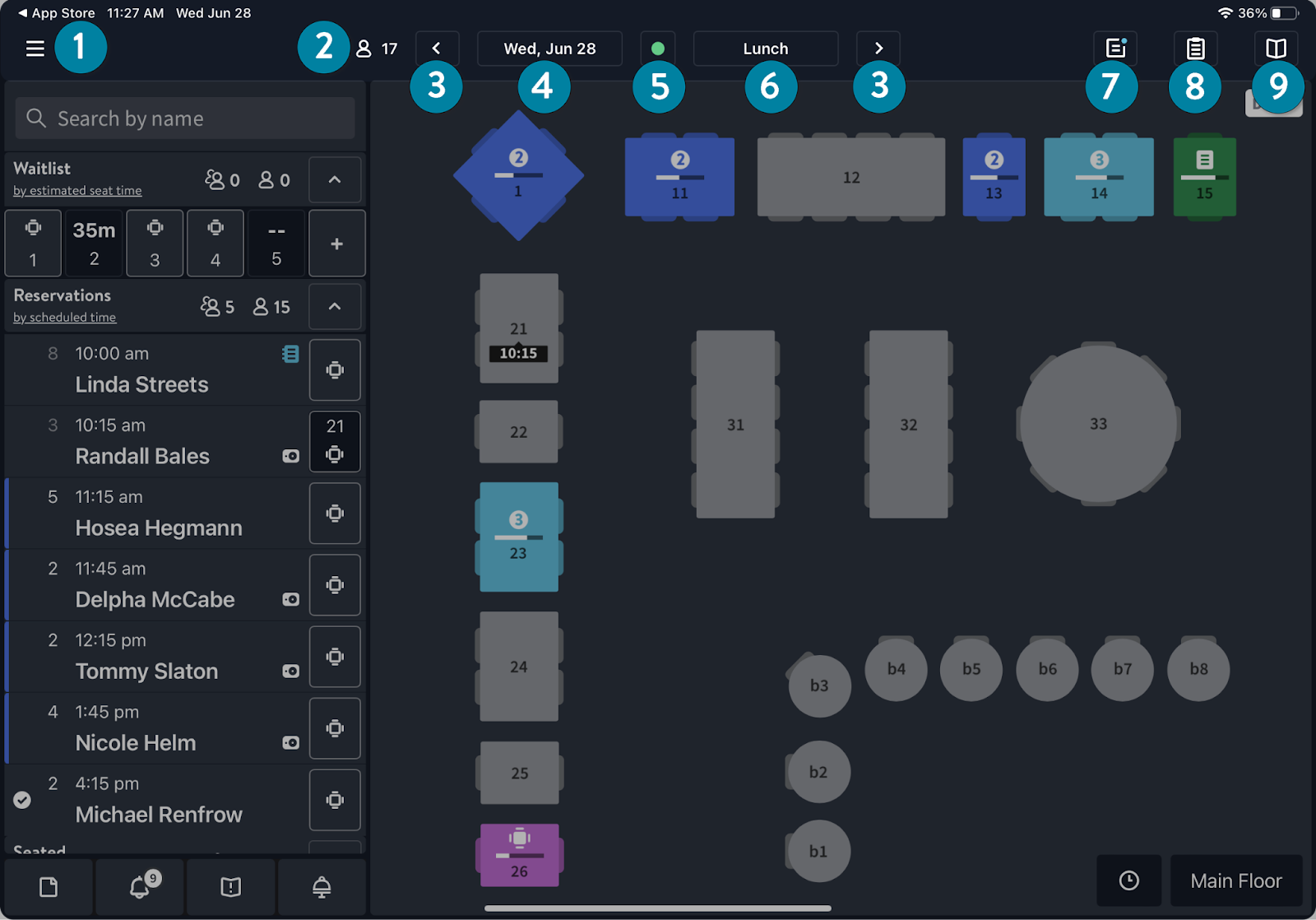
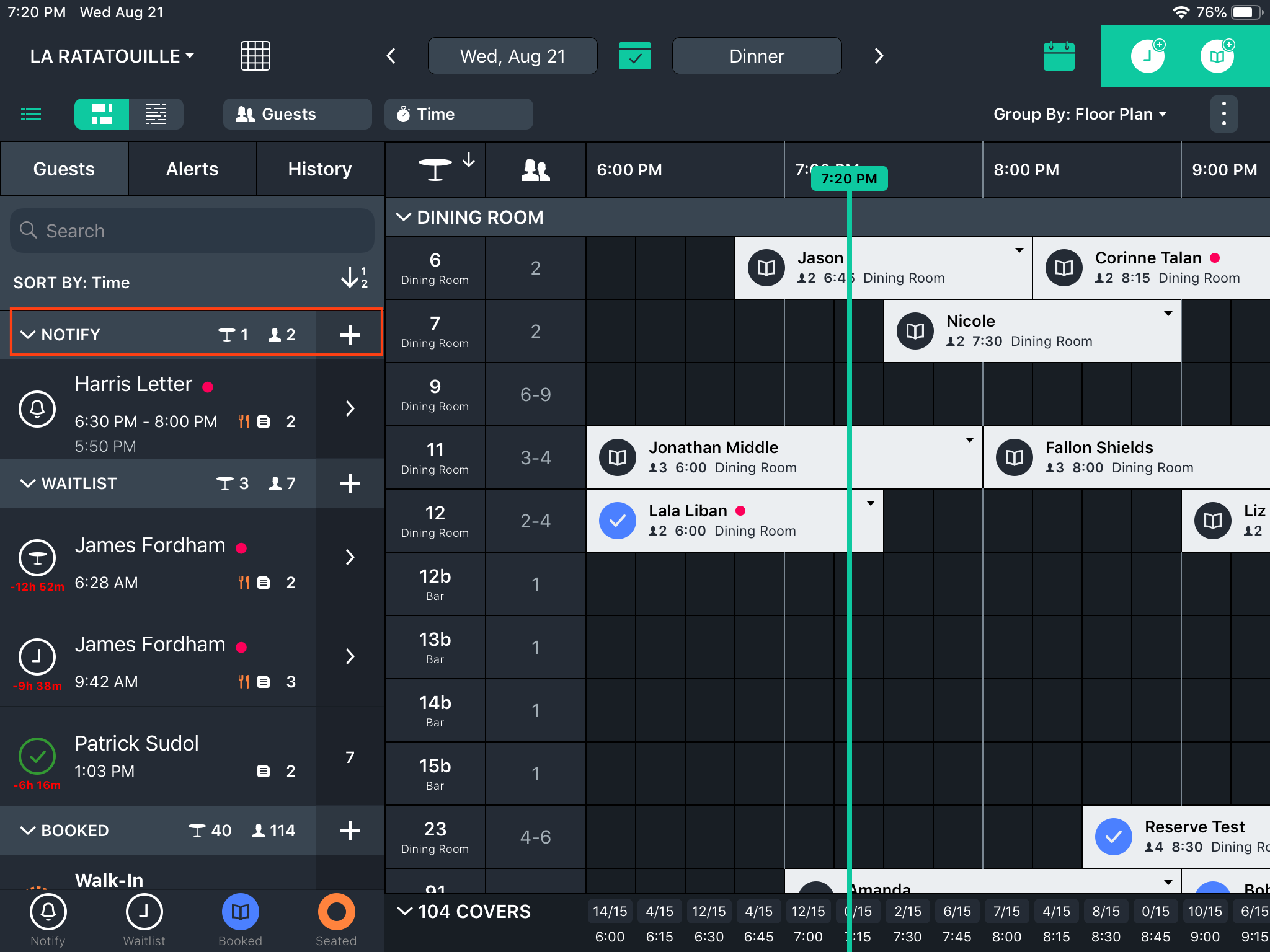
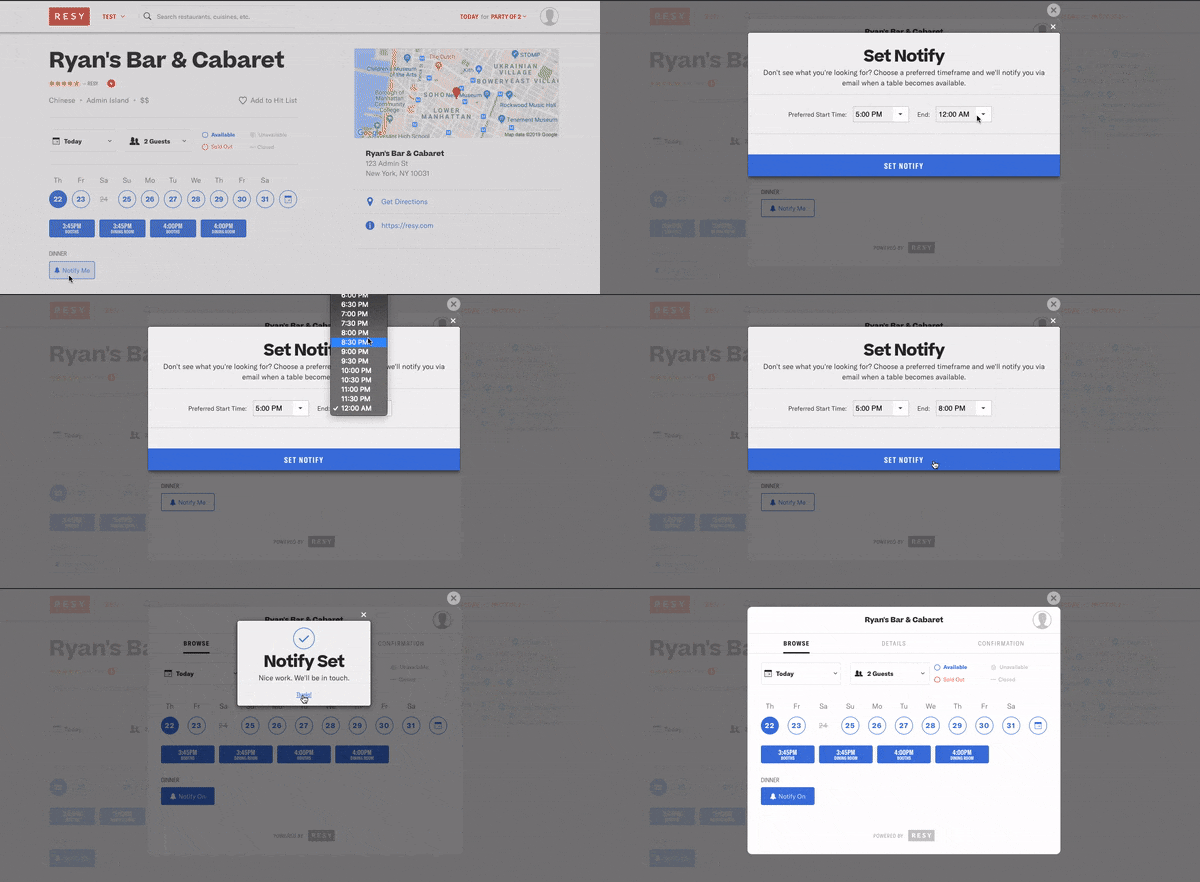
PHONE RESERVATIONS AND AI PHONE ANSWERING
“Can take a phone reservation” and “can answer the restaurant's phone with AI” are different claims. Both systems let restaurant staff record a reservation that arrived by phone. OpenTable says phone reservations do not carry cover fees. Resy documents staff booking workflows in ResyOS, and its pricing page lists Dashboard Booking, switching between venues from a browser, under Platform 360.
For automated answering, OpenTable has the clearer public ecosystem. Its documentation names voice-AI integrations such as Slang.ai and PolyAI, and its developer documentation distinguishes a Voice AI API for non-visual reservation experiences from its consumer online-booking API. The voice provider is a separate product, so operators must model its subscription or usage charges in addition to OpenTable.
Resy's public restaurant pricing and help documentation do not show an included AI phone-answering product or an equivalent public certified-partner directory. That is not proof that no implementation exists. It means a restaurant should request the partner name, supported booking actions, failure and handoff path, eligible plan and total monthly quote before assuming Resy will answer calls.
WAITLISTS, WALK-INS AND TABLE MANAGEMENT
Both systems handle walk-ins and live table operations. OpenTable lists customizable floor plans, Smart Assign, advanced inventory controls, access rules and in-house and online waitlists. Resy documents pacing, table inventory, walk-in waitlists, floor-plan assignment and quoted waits.
Resy Notify and OpenTable Notify Me are future-demand alerts: diners express interest and receive an alert if inventory becomes available. They are not the same as a confirmed reservation, and the alert may reach multiple diners. A physical waitlist, a remote waitlist and a future-availability alert should be tested as separate workflows.
During a demo, seat a walk-in while an online booking is late, move the party to a different table, quote a wait, release a cancellation and check what updates automatically. The quality of the host workflow is more important than whether a checklist simply says “waitlist: yes.”
GUEST CRM, NO-SHOWS, DEPOSITS AND EVENTS
Both platforms maintain guest profiles, notes and visit history. OpenTable's Pro plan emphasises richer relationship management, automated guest tags and more guest insights. Resy Platform 360 adds advanced analytics and automated guest insights. For a restaurant group, verify identity matching across locations, permissions, consent, data export, duplicate handling and whether POS spend reaches the correct guest record.
Both platforms support no-show controls, but the commercial model differs. OpenTable offers deposits, credit-card holds and prepaid experiences, with public 2% service fees on prepaid products. Resy supports credit-card holds, cancellation fees, deposits and prepayment; its Tock-powered Essential and Premium tiers explicitly price prepayment fees at 3% and 2%. Ask whether the restaurant or vendor controls refunds and disputes, when a card can be charged, and which payment-processing costs sit outside the advertised fee.
OpenTable supports experiences, ticketing and a separate private-dining lead product. Resy's combined 2026 plan set supports events, with the Tock-powered tiers designed for more advanced customisation, ticketing and experience workflows. Restaurants selling tasting menus, winery visits or prepaid events should compare refund rules, settlement timing, tax, chargebacks and guest communication, not only the monthly subscription.
POS INTEGRATIONS, APIS AND MULTI-LOCATION SUPPORT
OpenTable publishes the broader developer catalog. Its documentation covers Booking, CRM, Directory, Menus, POS, Private Dining, Reviews, Sync and Profile Content APIs. Access is not simply an anonymous public key: partners apply, restaurants work with their account team, and the correct booking API depends on whether the interface is visual or voice-based.
Resy's pricing page documents a Booking API and integrations across POS, discovery, CRM and other categories. Its help desk lists compatible POS systems including Square, Toast, Lightspeed K, Aloha, Simphony and others, subject to geography and plan. A smaller public catalog does not necessarily mean a weaker integration for a specific restaurant; ask for the exact fields, direction of sync, latency, alerting and support owner.
Both support groups. OpenTable has a clearly documented group and enterprise product. Resy serves hospitality groups and Platform 360 includes web Dashboard Booking that can toggle between venues. Multi-location buyers should compare central controls, local permissions, guest-profile sharing, cross-venue reporting, contract governance and support escalation.
DINER NETWORK: WHICH HAS MORE DINERS?
OpenTable has the larger documented operating footprint, but its published metrics should not be treated as directly comparable unique-user counts. OpenTable states that it serves 65,000+ venues and seats 1.9 billion diners annually. Resy states that it has 60 million+ registered users and more than 20,000 restaurants and venues; combined with Tock, the 2026 destination is expected to exceed 25,000 bookable venues.
A “diner seated,” “registered user” and “venue” measure different things. The useful restaurant-level number is how many incremental, profitable covers each network can deliver in your market. Ask each vendor for a 12-month local forecast, then separate diners who searched for your restaurant by name from diners who discovered it through the marketplace.
DOES RESY OR OPENTABLE WORK BETTER WITH AI AGENTS?
There are three separate AI jobs: consumer discovery, confirmed consumer booking, and restaurant-side phone answering. OpenTable documents discovery and booking relationships with OpenAI, Perplexity, Alexa+ and Google experiences, plus a purpose-built Voice AI API and third-party phone partners. Resy announced US restaurant reservations inside ChatGPT in August 2026, and its Claude connector surfaces discovery and availability before directing users through a Resy-owned booking path.
Official OpenAI documentation says ChatGPT's restaurant reservation conversion flow is in beta with approved partners. A generic public API, an MCP server, an AI search mention and eligibility for a ChatGPT Reserve button are therefore not interchangeable. Restaurants and software vendors should verify whether the assistant can read live inventory, return a confirmed reservation, modify or cancel it, apply policies and authenticate the guest.
Best current fit by AI job: OpenTable has the clearer documented restaurant-side phone-AI ecosystem. Resy has the clearest current public announcement for a reservation completed inside ChatGPT. For a custom restaurant assistant, both require commercial approval, integration testing and a precise failure path.
RESTAURANT OWNER PROS AND CONS
OpenTable pros
- The larger documented venue and annual-seating footprint.
- Strong discovery, distribution and affiliate reach.
- Broad APIs, POS coverage and voice-AI partner options.
- Mature table-management and restaurant-group tooling.
OpenTable cons
- Network-cover fees can exceed the subscription as volume grows.
- Basic charges for website covers as well as network covers.
- Voice AI is a separate vendor cost, not part of the base subscription.
- Public US contracts are annual and auto-renew unless notice is given at least 30 days before renewal.
Resy pros
- Predictable subscription with no public per-cover or per-reservation fee.
- Resy and American Express demand channels and a 60-million-user network.
- Resy Notify and a strong fit for in-demand, brand-led restaurants.
- Tock-powered tiers add prepaid event and ticketing depth.
Resy cons
- Higher entry subscription than OpenTable Basic.
- Advanced analytics and web Dashboard Booking require Platform 360.
- No equivalent public voice-AI partner ecosystem was found.
- Public developer and group documentation is less extensive than OpenTable's catalog.
WHICH IS BETTER FOR INDEPENDENTS AND RESTAURANT GROUPS?
Resy is not automatically better for every independent. It often fits an independent that already creates demand through reputation, neighbourhood, social channels and its own website, because the monthly bill remains predictable. OpenTable Basic can still cost less for a direct-first independent with few network covers, and OpenTable can justify higher variable fees when its marketplace fills tables that would otherwise sit empty.
OpenTable is not automatically better for every group. It has the clearer public enterprise product, broader API catalog and deeper documented integration ecosystem. Resy also supports hospitality groups and multi-venue workflows. Groups should run a proof of concept covering permissions, guest identity, reporting, POS sync, venue switching, support escalation and data export before choosing.
IF NEITHER BILLING MODEL FITS
Both platforms above ask a restaurant to choose a billing model before it chooses a workflow. Fork Time publishes this page and is the third structure in the comparison, so the numbers and the limits are both set out here.
Fork Time is an AI front of house. It answers guest calls and messages across phone, email, SMS, WhatsApp and web chat, and it holds the reservation book itself. US pricing is a flat monthly subscription for each location: $99 for Reservations, $199 for AI Front of House, $299 with phone ordering. There are no per-cover fees. At the 500 network cover and 500 website cover mix modelled above, the Reservations plan is $1,188 a year, against $11,376 on OpenTable Basic and $3,468 on Resy Platform.
Flat pricing is not a Fork Time invention. Resy, Tock, Yelp and Now Book It all sell without per-cover fees, and AI phone answering now ships from OpenTable partners and SevenRooms as well. Two capabilities are specific to Fork Time. It scores no-show risk on each booking and asks for a deposit only where the risk warrants it, so regulars book with nothing asked (no other system scores per booking). Walk-in Assist gives the host a ranked set of options at the walk-in moment: seat now, combine tables, a short wait from a finishing table, or a time-limited seat before the next reservation (no other system packages this).
Fork Time does not replace what OpenTable and Resy are usually bought for. There is no diner discovery network, no American Express audience, no gift cards, no ticketed events, and Fork Time integrates with two POS systems rather than twenty. A restaurant buying discovery should buy OpenTable. A restaurant buying the Amex dining audience should buy Resy. A restaurant whose tables are already booked but whose phone goes unanswered during service is the case Fork Time is built for.
| Published US price, 16 August 2026 | Subscription | Per-cover fee | Annual cost at 500 network + 500 website covers |
|---|---|---|---|
| OpenTable Basic | $149/month | $1.50 network, $0.25 website | $11,376 |
| OpenTable Core | $299/month | $1 network | $9,588 |
| Resy Platform | $289/month | None | $3,468 |
| Fork Time Reservations | $99/month | None | $1,188 |
METHODOLOGY, SOURCES AND DISCLOSURE
This comparison prioritises live vendor pricing pages, product pages, help centres, developer documentation and first-party announcements. “Not publicly documented” means the capability was not found in those materials on the review date; it does not mean the capability is impossible or unavailable through a private agreement. Marketing scale claims are attributed to the vendor and are not treated as audited market-share data.
Fork Time provides restaurant reservation and AI front-of-house software and is therefore commercially interested in this category. The page deliberately identifies where OpenTable and Resy are stronger. Images are public vendor support assets used editorially with attribution. Before signing, request a written fee schedule and test the actual floor plan, phone workflow, POS integration, AI booking path, guest-data export and cancellation policy.
Key primary sources include OpenTable plans and pricing, Resy plans and pricing, OpenTable API documentation, Resy integrations, OpenTable AI tools, Resy and Tock's 2026 integration announcement, Resy in Claude and the official ChatGPT restaurant reservation conversion specification.
COMPARE YOUR REAL BOOKING MIX
The cheapest plan is the one that fits the work.
Model the covers each channel produces, then test the booking, phone, waitlist, deposit and data-export workflows before signing.