SMART DEPOSITS
Deposits for the risky bookings. Nothing for your regulars.
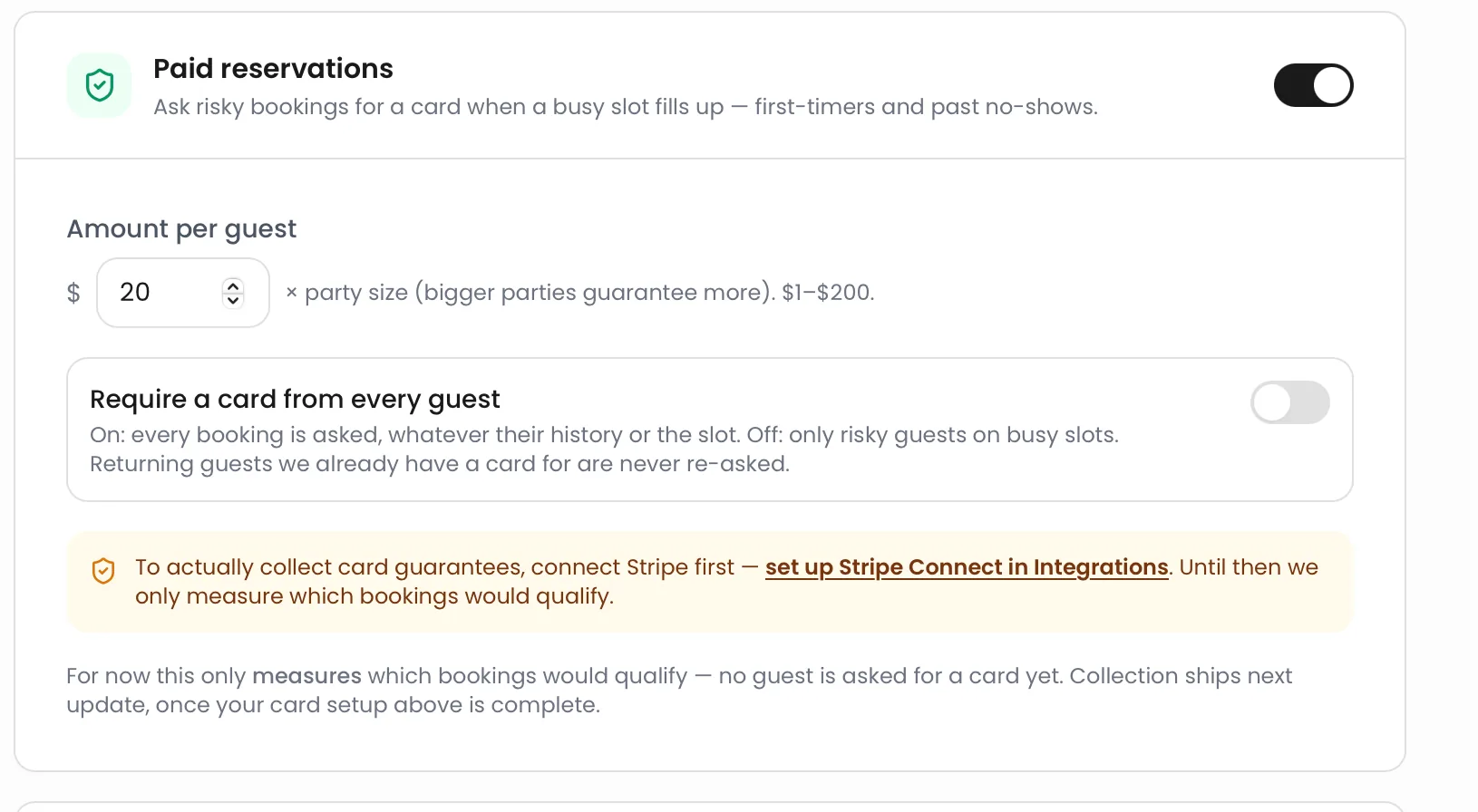
Smart Deposits is Fork Time's risk-based deposit system, applied per booking rather than as one policy for every guest. Instead of one blanket policy applied to every guest, Fork Time reviews each reservation as it is made and requests a card before confirming only when demand is high and the booking carries greater risk, such as a first-time guest, a peak service or a large party. Lower-risk guests book with nothing asked. No money is taken at booking: the card is held, and charged only if your team marks the booking as a no-show. You set when deposits apply and how much to request, every recommendation explains the reason behind it, and an authorised team member can override any recommendation. Deposits apply consistently across every channel, including phone, web, messaging and AI assistant bookings. Smart Deposits is included on every Fork Time plan from $99 a month.

THE TRUST TAX
A blanket deposit policy has inverted incidence. Call it the trust tax: the cumulative friction a single policy imposes on a restaurant's most loyal guests, who meet it most often precisely because they book most often.
A regular who books twenty times a year is asked for a card twenty times. A first-time guest is asked once. The friction therefore lands hardest, in aggregate, on the guests least likely to no-show, and lightest on the guests most likely to. That is arithmetic rather than opinion, and it is the strongest argument against applying one rule to everyone.
The cost is real on both sides. 44% of diners find a restaurant less appealing and stop trying when booking becomes difficult (Toast diner survey, 850 US adults), so a policy written to deter no-shows also deters bookings you wanted. Most systems ask you to choose between protection and friction, because a host cannot risk-assess every reservation at the moment it is made.
HOW IT WORKS
Fork Time scores each booking as it arrives, using signals such as guest history, demand on that service, party size and lead time. Low risk: the booking confirms with nothing asked. Higher risk: the booking flow or the call requests a card before confirming, with your policy stated plainly. If your team later marks the booking as a no-show, the card is charged.
The score, the decision and the outcome are recorded, so both the system and your team can see which bookings actually flake.
YOUR TEAM DECIDES
Every recommendation explains why it was made. Your restaurant sets the thresholds, the amounts and the cancellation window, and an authorised team member can override any recommendation at any time.
BEST FOR
Restaurants where no-shows concentrate in peak services, new guests and large parties. Venues that dropped deposits because of booking friction. Operators who want a defensible policy the system applies rather than one the host has to argue at six o'clock.
WHAT SMART DEPOSITS DOES NOT DO
It does not eliminate no-shows. A guest determined not to arrive will still not arrive, and a card hold is a deterrent rather than a guarantee. What changes is who carries the friction: the guests who create the risk rather than the guests who never did.
It is also the wrong tool for ticketed events and full-prepayment set menus, where every seat is paid for by design and there is nothing to score. And a venue with demand well below capacity should think carefully before asking anyone for a card, because in that room the cost of friction is higher than the cost of a no-show.