OPENTABLE ALTERNATIVES · REVIEWED JULY 2026
7 best OpenTable alternatives for restaurants
By Aadeel Khaan, CEO & Founder · Corrections: support@forktime.ai
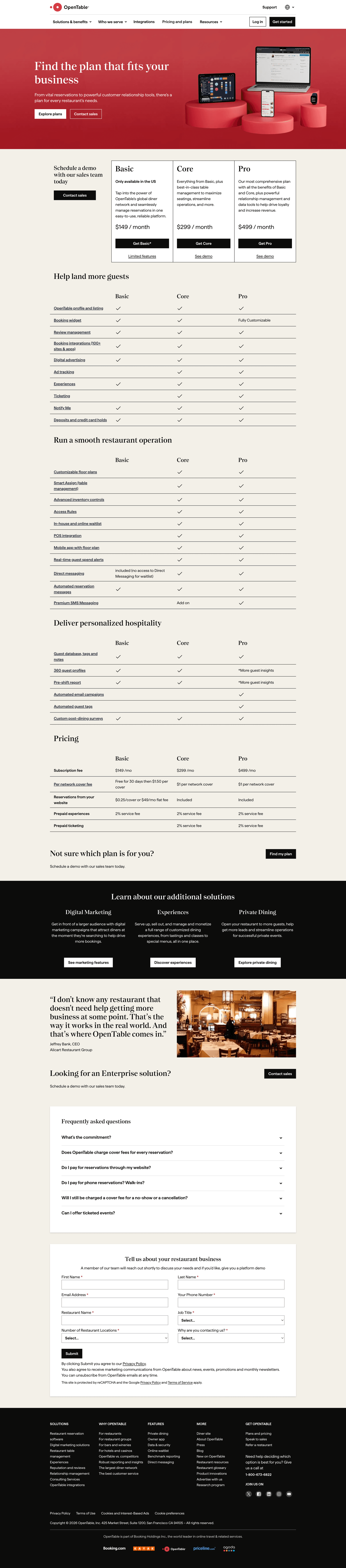
The best OpenTable alternatives in 2026 are Fork Time for independents who want AI answering every channel with no per-cover fees, SevenRooms for groups that live on CRM, Tock for ticketed and prepaid dining, Resy for brand-led rooms, Eat App for budget-conscious global operators, Toast Tables for venues already on Toast POS, and Now Book It for Australian venues that want gift cards and events. Restaurants leave OpenTable for one reason above all: the fees. OpenTable charges $149 to $499 a month, then $1.00 to $1.50 for every cover booked through its network, and in 2026 added a 2% service fee on deposits. A venue seating 150 network covers a week pays roughly $7,800 to $11,700 a year in cover fees before the subscription. That money buys diner discovery, and for venues that no longer need discovery, it buys a bill. Fork Time publishes this comparison and is one of the products evaluated; where another product fits better, we say so.
THE FEE MATH, FIRST
| Scenario | OpenTable annual cost | What a flat-fee system costs |
|---|---|---|
| 100 network covers/week, Core plan | ~$299 x 12 + $5,200-7,800 = $8,800-11,400 | Fork Time $199/mo = $2,388 |
| 150 network covers/week, Core plan | ~$3,588 + $7,800-11,700 = $11,400-15,300 | Fork Time $199/mo = $2,388 |
| 300 network covers/week, busy city venue | ~$3,588 + $15,600-23,400 = $19,200-27,000 | Fork Time $199/mo = $2,388 |
Plus, in the United States from early 2026, a 2% service charge on deposits, no-show penalties and prepaid dining. Not confirmed for Australia. The counterargument is real: some of those network covers are guests OpenTable brought you. The question this page answers is what to run when most of your covers are guests who already chose you.
WHY RESTAURANTS SWITCH
Per-cover fees on regulars. The fee applies whether the diner discovered you on OpenTable or searched your name and booked through the widget. You pay repeatedly for relationships you built.
Guest data. Profiles and histories accumulate inside OpenTable's network, and OpenTable is owned by Booking Holdings, whose business is the marketplace, not your restaurant.
Product age. Operator complaints cluster on dated interfaces and support, and a December 2025 outage put the dependency risk on display.
The AI gap. Guests now book by phone, message and AI assistant. OpenTable's voice answering arrived late through partners and its AI-assistant presence is thin, while challengers built for those channels first.
THE 7 ALTERNATIVES
1. Fork Time: best for independents replacing fees with AI
Fork Time costs $99, $199 or $299 USD per location per month. No per-cover fees, no contract, 14-day trial with no card.
Why people switch to it: the fee math above, plus capability OpenTable doesn't have: AI answering every channel from inside the system of record, deposits scored per booking rather than applied as one blanket policy, ranked cancellation-recovery offers, ranked walk-in seating options, and an MCP server that exposes booking tools to compatible clients configured with Fork Time.
Missing: the diner marketplace. Fork Time brings zero discovery traffic, and that is the honest core of the trade: OpenTable is worth its fees to venues that need to be found. No loyalty network, no multi-venue benchmarking, young platform with an early Australian base.
Migration: guest list and history export from OpenTable on OpenTable's terms; setup pulls menu, hours and brand from your URL.
Dealbreaker: if a third or more of your covers genuinely originate from OpenTable's network, keep OpenTable or run both until that changes.
2. SevenRooms: best for groups that run on CRM and events
~$299 to $499+ a month, no per-cover fees, owned by DoorDash since 2025. The deepest guest-data, marketing and events platform in the category.
Why people switch to it: CRM depth, automation, and event management that OpenTable doesn't match, without cover fees.
Missing: speed and simplicity. Onboarding runs 2 to 4 weeks, operators call the app hard to use, and it's priced and built for groups, not single sites. DoorDash ownership raises the same data question Amex does at Resy.
Dealbreaker: single-venue independents pay enterprise prices for depth they won't use.
3. Tock: best for ticketed, prepaid and experience dining
$199 to $699 a month plus 2% on prepaid reservations. Now merged under American Express with Resy.
Why people switch to it: prepayment and ticketing kill no-shows for tasting menus, events and wineries. Nothing else does committed-revenue dining as well.
Missing: casual-service flexibility. The 2% prepaid fee is a per-cover fee by another name for prepaid-heavy venues, and the Amex merger has the platform mid-reorganisation.
Dealbreaker: à la carte rooms without prepayment get little from the model.
4. Resy: best for brand-led rooms in Resy cities
~$249 to $399 a month, subscription only, no cover fees. Owned by American Express, now merging with Tock, with the Tock app closing.
Why people switch to it: flat pricing with real diner cachet in major US cities; the network effect without per-cover billing.
Missing: stability right now. The merger has brought diner login and booking complaints and slowed product work, and your guest data feeds Amex's consumer business.
Dealbreaker: outside Resy's strong cities the network is thin, and you're buying a brand mid-migration.
5. Eat App: best budget entry with global reach
$49 to $389 a month across tiers, operating in 90+ countries, WhatsApp-friendly, fast setup.
Why people switch to it: the lowest real entry price in the category with a genuine free tier, and strong support reputation.
Missing: the starter tiers meter messages (25 a month on the lowest plan), so the cheap price grows with use. No native AI voice.
Dealbreaker: message metering punishes exactly the venues that message guests most.
6. Toast Tables: best if you're on Toast POS
$50 to $199 a month as a Toast add-on.
Why people switch to it: one vendor, one screen, POS-native reservations at bolt-on prices.
Missing: depth. Reviews call it half-baked: a 25-reservation cap on lower tiers, wait-time misquotes, and a menu-data policy that drew operator backlash. It is a POS afterthought, not a front of house.
Dealbreaker: it requires Toast. No Toast, no Tables.
7. Now Book It: best for Australian venues wanting gift cards and events
Flat monthly fee, quoted on request, 11,000+ venues, AU-native support. AI receptionist available via Sadie, a third-party product owned by Valsoft, phone only.
Why people switch to it: the local flat-fee incumbent with revenue add-ons OpenTable lacks: gift cards, event ticketing, marketing.
Missing: published pricing, and an AI layer of its own. See our full Now Book It comparison for the two-system trade.
Dealbreaker: if AI across channels is the reason you're leaving OpenTable, a phone-only bolt-on recreates the gap.
VERDICT BY RESTAURANT TYPE
Independent full-service, one to three sites, established demand: Fork Time. The fee math is the argument, and the AI front of house is what the savings buy.
Multi-location group living in guest data: SevenRooms, if you'll use the depth and can carry the onboarding.
Tasting menus, events, wineries: Tock. Prepayment is the point.
Brand-led room in New York, LA or another Resy stronghold: Resy, with eyes open on the merger.
Tight budget, international, message-light: Eat App.
Already on Toast, simple needs: Toast Tables.
Australian venue that wants gift cards and functions: Now Book It.
Still need discovery: stay on OpenTable, or run OpenTable for the network alongside a flat-fee system for direct bookings, and move covers off the network as your direct channel grows.
Next step: book a demo built on your restaurant's own menu and service style, or talk to Fork Time yourself in the browser first.
Fork Time publishes this comparison and is one of the products evaluated. The same criteria were applied to every product, and where another platform is the better fit we say so. Pricing and features verified 22 July 2026. Corrections: support@forktime.ai.